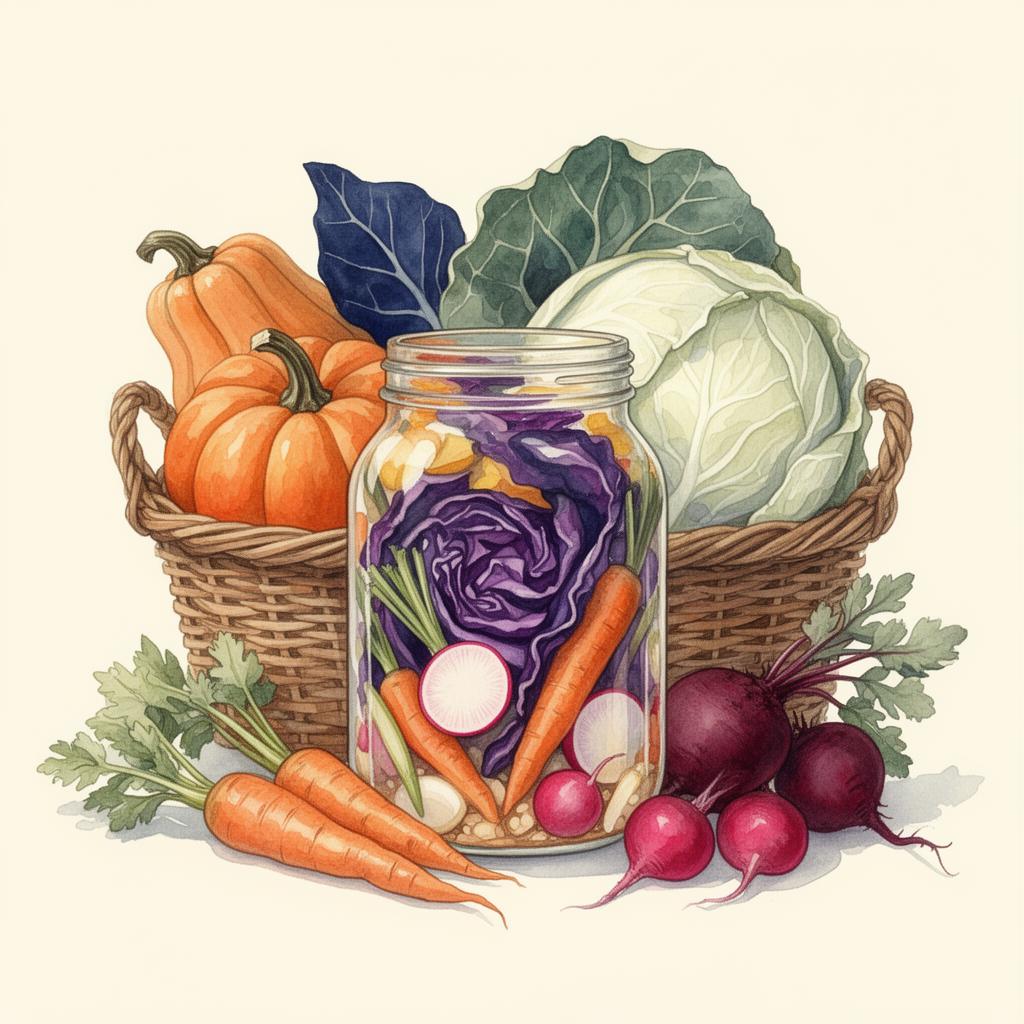
A jar of lacto-fermented vegetables with a seasonal basket.
1 · Introduction
Why ferment your food
Fermentation is not a trend. It is humanity's oldest biotechnology, predating by several thousand years our understanding of what it actually does. To a raw food it adds , B-group vitamins and increased mineral . It also removes things: antinutritional factors and the in legumes.
Beyond cabbage
Every vegetable can be lacto-fermented
We tend to associate lacto-fermentation with cabbage, because of sauerkraut. That view is narrow. Carrots, beets, radishes, turnips, squash, green beans, fennel, celeriac, onions, garlic, peppers, cucumbers, cauliflower, broccoli: all of them work. Each vegetable brings its own profile of sugars and fibres, and therefore its own aromatic and peptidic bouquet. A fermented beet is not a fermented cabbage, biochemically speaking.
Non-negotiable rule
Organic vegetables only
Lacto-fermentation uses the bacteria naturally present on the surface of the vegetable. On a conventional vegetable, those bacteria sit alongside systemic pesticide residues, which fermentation concentrates rather than removes. An organic vegetable arrives with its microbiome intact: that microbiome is exactly what does the work, for free, in your jar.
Living memory
Your great-grandmothers were right
They had no idea what a bioactive peptide was. But they knew that fermented milk kept well, was easier to digest, and that a sick child could still tolerate it when nothing else would do. It took a hundred years of biochemistry to formally prove them right.
1.5 · What science has measured
Three documented benefits, not three promises
Fermentation is one of the rare dietary practices backed by recent published human data. Here are the three best-documented benefits to date, with their level of evidence and primary source.
Benefit 1
Gut microbiome diversity
Six daily servings of fermented foods over ten weeks (yoghurt, kefir, kimchi, kombucha, lacto-fermented vegetables) significantly increased and lowered nineteen inflammatory blood markers, including interleukin-6. The "fibre-only" arm of the same trial did not reproduce this effect.
Source · Wastyk HC et al., Cell, 2021
Benefit 2
Higher mineral bioavailability
Microbial partially breaks down , which sequester iron, zinc, calcium and magnesium in grains and legumes. Sourdough bread or tempeh fermentation can increase non-haem iron absorption by 30 to 50 % compared to the same un-fermented food.
Source · Marco ML et al., Curr Opin Biotechnol, 2017
Benefit 3
Native bioactive peptides
Proteolysis releases , some of which are absorbed intact (Val-Pro-Pro and Ile-Pro-Pro from kefir, antioxidant peptides from miso). Moderate documented effect on blood pressure for fermented milks, weaker but convergent evidence for the other families.
Five gestures are enough. The margin of error is narrow on salt and temperature, wide on everything else. Lactic fermentation has the rare property of signalling its failures very clearly: a failed ferment is not dangerous, just obvious.
1
Choose and rinse
Fresh, firm organic vegetables. Quick cold rinse, no scrubbing. Preserve the surface bacterial layer: that's what inoculates the jar, for free.
2
Cut and salt at 2 %
Fine cut (grater, mandoline, julienne). Weigh the vegetables, add 2 % of their weight in non-iodised salt (20 g of salt per kilo). Massage for 5 to 10 minutes to release the juice.
3
Pack under brine
Pack tightly into a sealed jar. The vegetables must stay submerged in their own juice, at least 2 cm below the surface. A glass weight or a rolled cabbage leaf will do.
4
Seal, 18 to 22 °C, 7 to 14 days
Seal tightly. Keep away from light. Bubbles appear within 48 h, the jar may seep (put a plate underneath). That's the sign fermentation is running.
5
Taste, then refrigerate
After 7 to 14 days depending on vegetable and temperature, open and taste. Tangy, crunchy, aromatic: ready. Transfer to the fridge, where fermentation continues very slowly.
Storage and signs
✓ All is well if
Tangy, vinegar-like, slightly yeasty smell
Cloudy brine, fine bubbles, a thin white skin on top
Texture stays crunchy
Several months in the fridge, up to 12 months for sauerkraut
✗ Discard if
Fuzzy coloured mould (green, black, pink) on the surface
Putrid, ammonia-like, rotting smell
Stringy or unusually slimy texture
Vegetables emerged and exposed to air during fermentation
1.9 · The catalogue
Eleven foods to ferment, and what they become
Each food has its micro-organism, its time and its dominant nutritional transformation. Swipe to compare. The "before / after" values are indicative, drawn from USDA, ANSES and peer-reviewed averages.
Vegetable01 / 11
White cabbage (sauerkraut)
Micro-organism
Leuconostoc, Lactobacillus
Duration
10 to 21 days
Temperature
18 to 20 °C
Before
Vit C: 40 mg/100 g · Fibre: 2.5 g
After fermentation
Vit C 70 % preserved, vit K2 produced, iron bioavailability +50 %
Vegetable02 / 11
Lacto-fermented carrot
Micro-organism
Lactobacillus plantarum
Duration
7 to 14 days
Temperature
18 to 22 °C
Before
Beta-carotene: 8 mg/100 g · Sugars: 5 g
After fermentation
Beta-carotene +20 %, sugars converted to lactic acid, glycaemic index drops
Vegetable03 / 11
Beetroot kvass
Micro-organism
Lactobacillus, yeasts
Duration
5 to 10 days
Temperature
18 to 22 °C
Before
Nitrates: 250 mg/100 g · Betalains intact
After fermentation
Nitrates partly converted to NO, betalains bioavailable, hepatoprotective peptides
Antioxidant peptides, free isoflavones (absorbable aglycones), vit K2, high salt (10 to 12 g/100 g)
Soy11 / 11
Tempeh (cake)
Micro-organism
Rhizopus oligosporus
Duration
36 to 48 h
Temperature
30 to 32 °C
Before
Hulled soybeans · High phytates
After fermentation
Phytates -60 %, vit B12 produced (rare in plants), firm texture, highly digestible protein profile
1.95 · A parenthesis
Fermented cabbage and thyroid, what recent science actually says
Raw cabbage contains glucosinolates, whose breakdown products (goitrins) have historically been suspected of interfering with thyroid iodine uptake. That concern has recently been re-evaluated. A 2024 systematic review concludes that at normal intakes, in subjects with sufficient iodine status, brassicas do not alter thyroid function. And lacto-fermentation, far from making things worse, retains the beneficial glucosinolates (sulforaphane precursors) while partly deactivating their less favourable metabolites.
2 · Active exploration
Do you really know how to ferment?
Ten questions. The wrong answers are widely held beliefs, not absurdities. The point: to ferment the brain, just enough.
Question 1 / 11Score : 0
When lacto-fermenting organic vegetables, how much salt do you use?
3 · Fermentation through history
What every civilisation discovered on its own
Every great culture has fermented, without consulting one another, on every continent, with biologically convergent results. Swipe to travel.
Mesopotamia7000 BCE
Beer and sourdough bread
The Sumerians fermented beer and sourdough bread. They had twenty words for beer, by degree of fermentation.
China2500 BCE
Miso and fermented tofu
Proteolysis of soy releases antioxidant peptides that 20th-century chemistry eventually got around to naming.
Northern Europe17th century
The sailors' sauerkraut
Dutch sailors took sauerkraut on board to prevent scurvy, with no idea that fermentation was raising the bioavailability of vitamin C.
CaucasusAntiquity
Kefir grains
Kefir grains form a bacterial and fungal consortium so complex that no one has yet managed to synthesise it from scratch in a lab.
JapanEdo period
Shiro miso and red miso
Cooks already distinguished white miso (a short three-week ferment) from red miso (twelve months). Two different peptide profiles, mastered empirically.
KoreaSilla kingdom
Kimchi
Long before chilli (imported in the 17th century), Koreans were already fermenting cabbage, radishes and turnips in buried jars, the vegetable cousin of a cheese cellar.
"None of these civilisations needed a PhD in biochemistry. They had something more powerful: time, observation, and a lack of alternatives."
4 · Conclusion
Fermentation, the source of today's techniques
What biotech labs do today with mass spectrometers and AI models, your jars do with salt, time and . The difference is not in the biochemical outcome: the peptides produced are often the same. It lies in concentration, precision, and the ability to target a specific therapeutic effect.
Peptide supplementation is, in a way, an accelerated, purified and dose-controlled fermentation: an process reproduced in a controlled environment. Understanding one helps you assess the other clearly, without confusing a jar of kimchi with a medication, or underestimating what that jar is actually doing.
Sources
References from peer-reviewed journals. Levels of evidence: systematic reviews and randomised clinical trials in priority.
[01] Wastyk HC, Fragiadakis GK, Perelman D, et al.
Ce site utilise des cookies et collecte des données (e-mails, progrès dans les explorations) pour améliorer votre expérience. Lire notre politique de confidentialité.