
Vagus nerve and sound: why certain frequencies truly calm
The vagus nerve doesn't only connect the brain to the gut organs. One of its small branches reaches into the ear. This is the anatomical explanation for what every tradition discovered without naming it: certain sounds transform you from the inside.
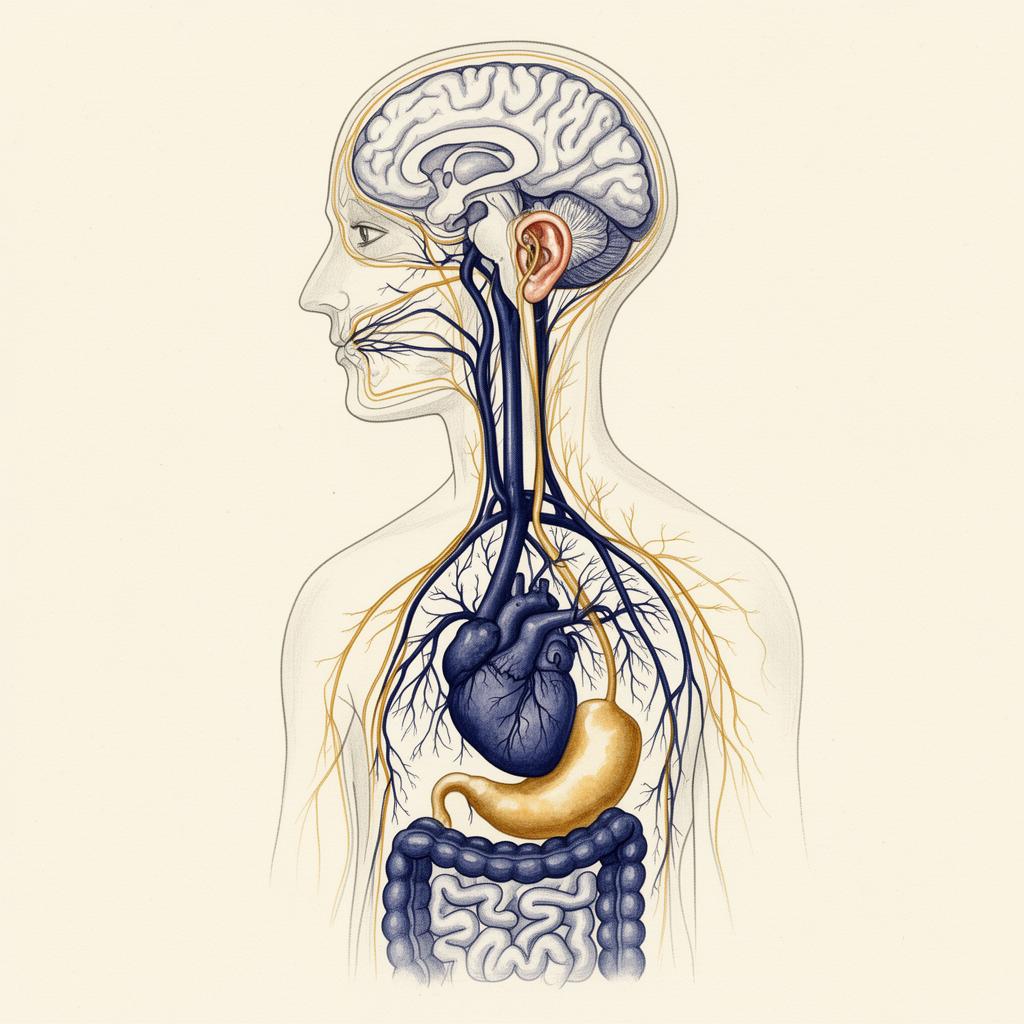
Three targeted frequencies to activate parasympathetic relaxation. Headphones recommended: deep thoracic vibrations trigger the vagus nerve response before they are even heard by the ear.
A branch of the vagus nerve runs through your ear
The vagus nerve is one of the major nerves coming out of the brain (the tenth out of twelve). It sends a small branch into the hollow of the outer ear, right before the ear canal. So that spot can be stimulated from the outside, without surgery. That's exactly what some hospitals do today with a small device clipped on the ear to help patients with depression or epilepsy that no longer respond to medication.
A two-way nerve that can also wake you up
It's often described as the body's 'brake', the one that slows the heart and calms you down. That's only half the story. The vagus nerve is 80 % sensory: it mostly carries information from the body up to the brain, far more than the other way around. Depending on the frequency you stimulate it with, it can relieve severe depression (in clinical use since 2005, approved by the US FDA) or simply slow your heartbeat. It's not an on/off switch, more like a dial with several settings.
Why humming dilates blood vessels
Humming with the mouth closed multiplies measured nasal nitric oxide (NO) by 15. NO is an endogenous vasodilator: it relaxes artery walls. It is the mechanical opposite of stress, which constricts vessels. Every religious tradition, Gregorian chant, mantra, Om, Corsican polyphony, gnawa, selected this practice without knowing the biochemistry.
Heart, gut, brain: an electrical orchestra
The body runs on three major electrical rhythms. The heart, whose steady beat entrains the brain via the vagus nerve. The gut, which has its own conductor cells (the cells of Cajal, discovered in 1893) generating the slow waves that move digestion forward. The brain, whose electrical waves govern attention and memory. When these three rhythms fall out of sync, we casually call it jet lag. But it also happens without ever boarding a plane: shifted meals, evening screens, never-ending stress.
Sound has a superpower here: it's the only signal you can impose on all three at once. A stable low note (a held tone, a bourdon, the voice of a Tibetan chant) gives your heart, gut and brain a shared temporal reference, like a common metronome. Neuroscience calls this 'entrainment' — your inner rhythm locks onto the outer rhythm.
The hidden circuit linking gut to dopamine
Vagus fibres rising from the gut reach a small relay at the base of the brain, then connect to the areas that produce dopamine, the messenger of pleasure and motivation. In other words, stimulating the vagus through the belly activates the reward pathway, bypassing the tongue and even conscious thought. This circuit explains why certain low sounds, a bourdon, the rumble of a didgeridoo, a voice resonating in the chest, trigger a sense of fullness that's hard to put into words.
Walter Cannon, 1942: when belief kills via the vagus
In 1942, US physiologist Walter Cannon gathered cases of death by sorcery observed across cultures (what he called 'Voodoo Death'). His hypothesis, since confirmed by modern cardiology: the deep conviction of being doomed can activate the vagus nerve so strongly that the heart slows to a stop. The vagus is therefore not only a relaxation nerve, it's also the channel through which belief inscribes itself in the body. It's the biological version of the nocebo effect (the opposite of placebo: when you're convinced something will harm you, the body obeys).
Practise on Nutrilexic
Two tools on the site put the above into practice: heart coherence entrains heart, brain coupling via the vagus nerve; the Musical Garden layers a harmonic drone and natural textures to activate the parasympathetic pathway without cognitive effort. The Stress hub ties together every physiological lever.
This exploration is educational and does not replace medical advice. Clinical vagal stimulation (VNS, tVNS) requires specialist indication and follow-up. Terms and conditions →
- Peuker ET, Filler TJ. « The nerve supply of the human auricle ». Clin Anat, 2002.
- Yap JYY et al.. « Critical Review of Transcutaneous Vagus Nerve Stimulation: Challenges for Translation to Clinical Practice ». Front Neurosci, 2020.
- Eby GA. « Strong humming for one hour daily to terminate chronic rhinosinusitis (nitric oxide hypothesis) ». Med Hypotheses, 2006.
- Lundberg JO et al.. « Humming greatly increases nasal nitric oxide ». Am J Respir Crit Care Med, 2002.
- Han W et al.. « A Neural Circuit for Gut-Induced Reward (vagal sensory neurons, NTS, SNc dopamine) ». Cell, 2018.
- Kaniusas E et al.. « Current Directions in the Auricular Vagus Nerve Stimulation I. A Physiological Perspective ». Front Neurosci, 2019.
- Sanders KM et al.. « Interstitial cells of Cajal as pacemakers in the gastrointestinal tract ». Annu Rev Physiol, 2006 (Cajal, Nobel 1906).
- Cannon WB. « « Voodoo » Death (hyperactivation parasympathique fatale) ». American Anthropologist, 1942 ; repris J Am Soc Nephrol 2002.
- Rush AJ et al.. « Vagus nerve stimulation for treatment-resistant depression: a randomized, controlled acute phase trial ». Biol Psychiatry, 2005.