
Nutrilexic · Peptides · Animated diagram
Peptides and mitochondria the molecular language of energy
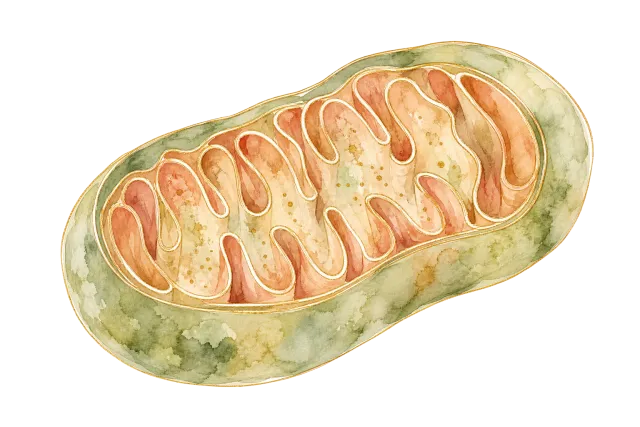
Your cells talk to each other constantly through short folded chains of amino acids: peptides. Three of them target the mitochondrion directly, the organelle that produces 90% of your energy. It is one of the most active research frontiers today, accelerated by artificial intelligence.
From amino acid to molecular key
Four levels of folding, one single function
A peptide only acts if it is correctly folded. This 3D shape is dictated by its sequence of amino acids, but it emerges from a four-step staircase. This is the folding that AI now learns to predict - and to design.
- LEVEL 1
Primary
Linear chain of amino acids, like pearls on a string.
- LEVEL 2
Secondary
The chain coils into an α-helix or folds into a β-sheet.
- LEVEL 3
Tertiary
The whole folds onto itself into a unique stable 3D shape.
- LEVEL 4
Quaternary
Several folded chains assemble into a functional complex.
When the key enters the lock
The peptide docks onto its mitochondrial target
Picture a microscopic lock on the surface of a protein inside the mitochondrion. The peptide, in green, is the only key that fits. When it clicks in, it triggers a precise mechanism - for instance restarting energy production or protecting the membrane.
- STEP 01
The peptide circulates
Thousands of peptides float in the blood or inside the cell. Each one has a unique 3D shape, dictated by its sequence of amino acids.
- STEP 02
It meets its target
On the surface of a mitochondrial protein lies a cavity, the "pocket". Only the exactly complementary shape can enter it.
- STEP 03
The key enters the lock
The peptide locks in by shape and charge complementarity. The bond is so precise that it excludes other molecules.
- STEP 04
The cell changes behaviour
The docking triggers a signal: the respiratory chain restarts, the membrane is protected, free radicals decrease.
What AI now makes possible
Four gestures that biology alone needed years to perform
AI does not replace biology: it accelerates how we read and write it. Where it took ten years to crystallise a protein, AlphaFold predicts its shape in hours. This compression of time opens a new window on so-called "incurable" diseases, which increasingly look like software bugs of the living, correctable provided we know the broken part.
- 01
Reading the genome
Sequence a person's DNA fast and cheaply, spot variants that predispose to mitochondrial fragility or to a repair defect.
- 02
Folding proteins
With AlphaFold, predict the 3D structure of a protein from its sequence. The 2024 Nobel revolution: we finally see what we used to guess.
- 03
Mapping glycans
Decode the sugar tags that coat every cell. They tell which tissue it belongs to, whether it is young, tired or cancerous.
- 04
Designing a peptide
From the three previous readings, generative models propose an amino-acid chain whose folded shape docks precisely onto the chosen target.
Going further
Living foods and peptides
Before thinking of synthetic peptides, your gut receives thousands of peptides every time you eat a fermented food. Fermentation releases active protein fragments that your body can absorb directly.
Explore living foods and peptides →This exploration is educational. The mitochondrial peptides mentioned are under clinical evaluation: this content is not medical advice nor a therapeutic recommendation. Legal notice
Scientific sources
- Lee C. et al. - MOTS-c Promotes Metabolic Homeostasis (Cell Metabolism 2015)
- Hashimoto Y. et al. - Humanin, a Rescue Factor Abolishing Neuronal Cell Death (PNAS 2001)
- Yen K. et al. - Humanin in Aging and Age-Related Diseases (Aging 2020)
- Birk A.V. et al. - SS-31 Re-Energizes Ischemic Mitochondria via Cardiolipin (JASN 2013)
- Karaa A. et al. - MMPOWER-3 : Elamipretide in Primary Mitochondrial Myopathy (Neurology 2023)
- Jumper J. et al. - Highly Accurate Protein Structure Prediction with AlphaFold (Nature 2021)
- The Nobel Prize in Chemistry 2024 - Hassabis, Jumper & Baker