
Nutrilexic
    Back to Peptides
    Nutrilexic · Peptides · GLP-1 and the brain

    GLP-1 and the brain,

    beyond weight

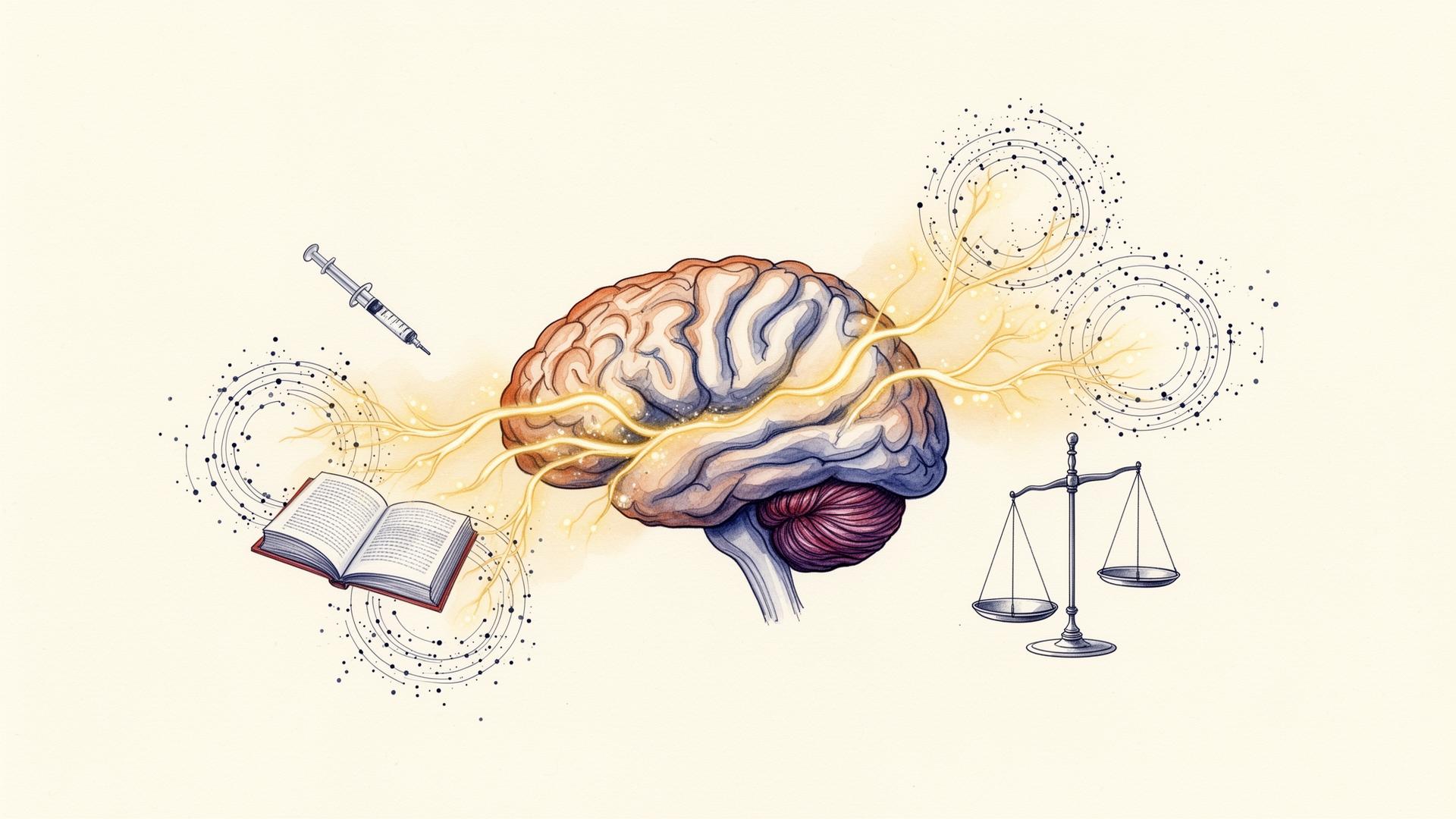
    Editorial illustration: a watercolor brain, dotted reward circuits, a pen injector, a book and scales, beyond weight.

    You were told Ozempic makes you lose weight. What you're not being told yet: the same peptide acts on the brain's reward circuits, reduces cravings for alcohol, nicotine and sugar, and shows promising signals against depression. may be becoming the most important therapeutic class since antidepressants.

    Peer-reviewed sources, informed by the clinical experience of naturopaths.

    1 · A neurotransmitter that didn't know itself

    Your brain also makes GLP-1

    GLP-1 is produced by the of the gut, but also by specific neurons in the . These neurons project to regions involved in reward, motivation and emotional regulation: the , the amygdala, the prefrontal cortex.

    That is to say, GLP-1 is not only a satiety signal. It is a neurological modulator acting on the same as drugs, alcohol and compulsive behaviours.

    2 · Four new indications under evaluation

    Beyond obesity: what clinical trials are exploring

    Four distinct clinical fronts, at different stages of evidence. Swipe to compare.

    Indication 1

    Alcohol

    Result
    An RCT published in JAMA Psychiatry (2025) shows that low-dose semaglutide significantly reduces alcohol cravings and consumption over 9 weeks. A Nature Communications study (2024) links semaglutide to a 50–56% reduction in relapse risk in alcohol use disorder.
    Evidence level
    Moderate, phase 3 trials ongoing

    Source : Hendershot et al., JAMA Psychiatry, 2025

    Indication 2

    Nicotine and tobacco

    Result
    An RCT with exenatide (the first approved GLP-1) shows added benefit for smoking cessation combined with the nicotine patch. Observational data confirm reduced smoking urges under semaglutide.
    Evidence level
    Low to moderate, mostly observational

    Source : Endocrine Society, October 2025

    Indication 3

    Opioids

    Result
    In animal models, several GLP-1s reduce self-administration of heroin, fentanyl and oxycodone. A randomized clinical trial is ongoing (ClinicalTrials.gov NCT06548490).
    Evidence level
    Low in humans, solid preclinical

    Source : Endocrine Society 2025 / ClinicalTrials.gov 2024

    Indication 4

    Depression and cognition

    Result
    Observational data link GLP-1s to a reduction in depressive symptoms. Proposed mechanism: reduced brain inflammation and dopaminergic modulation. No phase 3 RCT published to date.
    Evidence level
    Low, solid mechanistic hypothesis

    Source : Ali et al., Prim Care Companion CNS Disord, 2025

    3 · The shared mechanism

    Hunger and addiction share the same circuit

    Cravings for food, alcohol, nicotine or sugar activate the same brain regions: the . GLP-1 modulates this circuit by reducing the response to reward stimuli, whether a plate of fries or a glass of alcohol.

    That is to say, does not specifically target alcohol. It dampens the brain's response to anything that triggers a compulsive craving. This is both its strength and the reason some patients report a general loss of motivation as a side effect worth monitoring.

    The effects of GLP-1s on addiction and depression are not yet approved by the FDA or the . Available data are promising but preliminary. This exploration is educational.

    4 · What this changes for Nutrilexic

    And what about food in all this?

    If GLP-1s act on reward circuits, stimulating your natural GLP-1 through food is no longer just a question of weight. It is potentially a way to modulate your cravings, your mental energy and your resilience to compulsive behaviours.

    This is not a therapeutic claim. It is a serious mechanistic hypothesis, consistent with what research is starting to document. The science is only at the beginning.

    Sources
    • Hendershot CS et al.. « Once-Weekly Semaglutide in Adults With Alcohol Use Disorder: A Randomized Clinical Trial ». JAMA Psychiatry, 2025.
    • Wium-Andersen MK et al.. « GLP-1 receptor agonists and risk of relapse in alcohol use disorder ». Nature Communications, 2024.
    • Endocrine Society. « GLP-1 medications show promise for tobacco and opioid use disorders ». Endocrine Society press release, October 2025.
    • Yammine L et al.. « Exenatide as adjunctive therapy for smoking cessation: a randomized clinical trial ». JAMA Network Open, 2021.
    • Klausen MK et al.. « GLP-1 receptor agonists in the central nervous system: from preclinical to clinical applications in addiction ». Trends in Pharmacological Sciences, 2024.
    • Ali MA et al.. « GLP-1 receptor agonists and depression: an emerging therapeutic frontier ». Primary Care Companion for CNS Disorders, 2025.
    • Drucker DJ. « The benefits of GLP-1 drugs beyond obesity ». Science, 2024.

    This information is not medical advice but an interesting topic to discuss with your health professional. Terms and conditions →

    Going further
    What your plate does that Ozempic doesn't

    Seven foods that stimulate your natural GLP-1, and three things food does that analogues don't: preserve muscle, act without rebound, feed your microbiota.

    Explore Plate vs Ozempic

    Ce site utilise des cookies et collecte des données (e-mails, progrès dans les quiz) pour améliorer votre expérience. Lire notre politique de confidentialité.