WHO · alert
Top-10 global threat
The WHO ranks antibiotic resistance among the ten greatest threats to global public health.
WHO

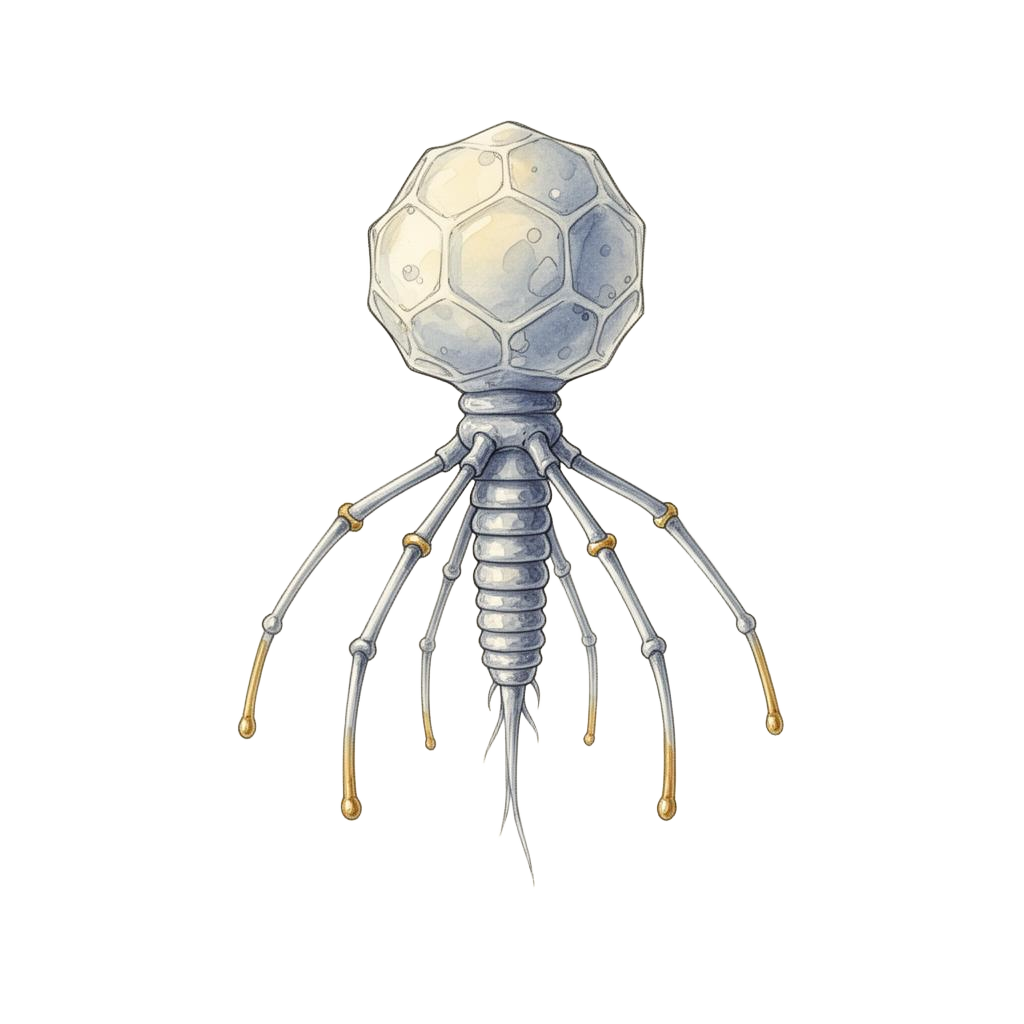
Antibiotic resistance is now recognised by the WHO as one of the top ten threats to global public health. In response, research has turned toward strategies that complement or offer alternatives to conventional antibiotics: bacteriophages, naturally occurring viruses that exclusively infect bacteria, are among the most actively studied avenues.
The WHO ranks antibiotic resistance among the ten greatest threats to global public health.
The Lancet (2022): 1.27 million deaths directly attributable to antimicrobial resistance, and nearly 5 million associated deaths.
If current trends continue, more than 39 million cumulative deaths are expected by 2050.
Faced with this impasse, research is exploring strategies that complement antibiotics. Bacteriophages, natural viruses that infect only bacteria, are among the most studied.
A bacteriophage follows a five-step cycle to destroy its target bacterium. The animation below walks through each step.
Animation interactive
Le phage reconnaît et se fixe sur des récepteurs spécifiques présents à la surface de la bactérie cible, via les fibres de sa queue. Cette reconnaissance est extrêmement précise : un phage donné n'infecte généralement qu'une espèce, parfois une seule souche bactérienne.
Schéma basé sur Explor Drug Sci. 2025;3:1008133 et MedComm 2025 (PMC12256688). Représentation pédagogique simplifiée, à visée éducative uniquement.
The phage recognises specific receptors on the surface of a particular bacterium and attaches to it. Specificity is very narrow: a given phage typically infects one species, sometimes a single strain.
The phage punctures the bacterial cell wall and injects its genetic material inside, without entering the cell itself.
The viral genome takes control of the cell, which begins producing the components needed to build new phages.
The viral components self-assemble into complete particles inside the infected bacterium.
Two viral enzymes, holin and endolysin, degrade the inner membrane and the cell wall (peptidoglycan). The bacterium bursts, releasing dozens to hundreds of new phages.
The core difference with an antibiotic: an antibiotic works through a broad-spectrum chemical mechanism that often indiscriminately affects many bacterial species, including those of the microbiome. A phage works through a physical, targeted destruction mechanism aimed at a single species, sometimes a single strain, without directly affecting the surrounding bacterial flora. This specificity explains the absence of cross-resistance with antibiotics.
Contrary to a claim sometimes repeated, the historical foundation of clinical phage therapy lies in Georgia and Poland. It is a French biologist, Félix d'Hérelle, who co-discovered bacteriophages in 1917, before the field was largely abandoned in the West in favour of antibiotics.
The world's oldest bacteriophage research and clinical centre, in continuous operation for a century. Specialities: internal medicine, urology, gynaecology, paediatrics. Patients from around the world.
Phage Therapy Unit established under Prof. Andrzej Górski. Branches in Kraków and Częstochowa. One of the few European centres offering structured access to experimental phage therapy.
Programme led by Prof. Laurent and Prof. Ferry at the Hospices Civils de Lyon. On 28 May 2026, the ANSM granted the HCL a manufacturing authorisation for purified therapeutic phages: a first in France and the EU for a public institution.
The French pathway in detail. Since 2017, the PHAGEinLYON programme, led by Prof. Frédéric Laurent and Prof. Tristan Ferry at the Hospices Civils de Lyon (Croix-Rousse and Édouard Herriot hospitals), has been isolating, characterising and producing therapeutic phages on French soil. Phages are collected from the environment (notably wastewater), tested against the patient's bacterial strain, then assembled by a pharmacist into cocktails of two or three phages before administration, under the supervision of the French medicines agency (ANSM) and within a strictly compassionate-use framework.
In a letter dated 28 May 2026, the ANSM granted the HCL an authorisation to manufacture Pharmaceutical-Grade Raw Material (MPUP) for purified therapeutic phages, a first in France and in the European Union for a public healthcare institution. This authorisation paves the way for secure, GMP-compliant production, and for scaling toward a national phage therapy pathway carried by the PHAG-ONE project and the THERAPhage research hospital-university programme, both funded by the French National Research Agency.
The scientific literature has seen a notable acceleration recently.
First randomised demonstration of efficacy for intravenous phage therapy in complicated S. aureus bacteraemia. Day-12 clinical response: 88% (phage + ATB) vs 58% (placebo + ATB), p = 0.047.
Systematic review: promising clinical results for both personalised and standardised phage therapy, but only 9 randomised trials identified across the entire body of evidence.
Chinese trial on ventilator-associated pneumonia (A. baumannii, P. aeruginosa, K. pneumoniae). In France, PHAGEinLYON cohort (NCT06185920): ~100 compassionate-use patients since 2017, enrolment through 2028.
The most extensively studied pathogens remain Pseudomonas aeruginosa (hospital-acquired infections, cystic fibrosis) and Escherichia coli (multidrug-resistant urinary tract infections). In France, the Lyon team documented in 2024 (International Journal of Antimicrobial Agents) the implementation of its access programme since 2022, primarily for complex bone and joint infections linked to prosthetics or implants.
E. coli's role as a tool serving human health goes beyond phage therapy. The same bacterium, known for strains responsible for multidrug-resistant urinary tract infections, is also widely used as a production platform in bio-engineering. This is notably the case for GLP-1, the gut hormone at the heart of type 2 diabetes and weight-loss treatments (semaglutide), whose peptide sequence can be produced by fermentation of genetically modified E. coli strains.
The same bacterial species sits both on the problem side (resistant infections) and on the solution side (production of therapeutic molecules), depending on the strain and context.
To explore GLP-1 and metabolic peptides further, head to our dedicated exploration.
Four points to keep in mind, to avoid confusing promise with everyday access.
Since 28 May 2026, the HCL manufacture under GMP. Phage therapy still has no conventional marketing authorisation: access remains compassionate-use, decided in multidisciplinary case review, under ANSM supervision. No public pathway, no outpatient prescription.
For patients who do not fall under French protocols (notably in Lyon), travel to the historic centres in Georgia or Poland remains a route documented in the literature.
Bacteria can develop resistance to phages, just as they do to antibiotics. Hence the shift toward multi-phage cocktails, or protocols combining phages and antibiotics synergistically.
The 2025 meta-analysis notes that trials remain poorly standardised (personalised vs fixed preparations), which complicates direct comparisons between studies.
The underlying appeal of phage therapy, from a naturopathic perspective, lies in its logic of targeting: acting on a precise cause without disrupting the broader bacterial ecosystem, an approach that echoes a philosophy of caring for the terrain rather than broad-spectrum eradication.
Sources last verified: June 2026.
Ce site utilise des cookies et collecte des données (e-mails, progrès dans les explorations) pour améliorer votre expérience. Lire notre politique de confidentialité.