Essential
Omega-6 fats are essential: skin, brain, immunity cannot do without them.
Innes & Calder, 2018

Why omega-6 fats are not the devil
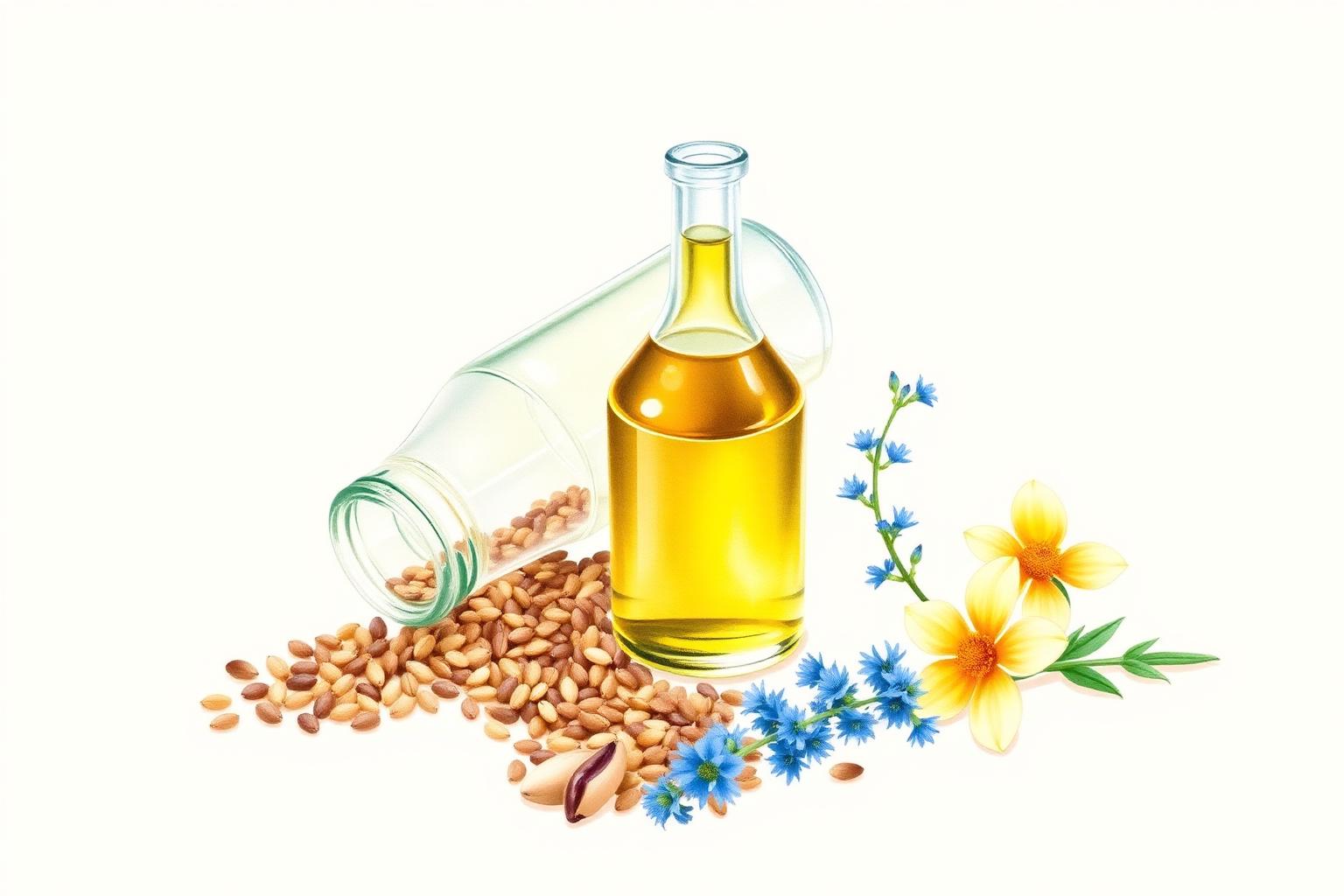
Omega-6 fats get a bad press. Pro-inflammatory, unbalanced ratio with omega-3, blamed for everything. The reality is subtler: they are essential, indispensable for skin, brain, immunity. The issue isn't their absolute quantity, nor their demonisation, but how your FADS1 and FADS2 genes transform them, and the dietary context they arrive in.
Omega-6 fats are essential: skin, brain, immunity cannot do without them.
LA → GLA (anti-inflammatory) → AA (pro- or anti- depending on downstream enzymes).
Your variants determine whether you convert fast, slowly, or barely at all.
Recent meta-analyses nuance the omega-6 / omega-3 obsession.
Cold-pressed versus refined and heated: the context changes everything.
Linoleic acid (LA) from sunflower, corn, soy oils is the precursor. The body converts it to gamma-linolenic acid (GLA, anti-inflammatory), then to arachidonic acid (AA, which can swing pro- or anti-inflammatory depending on downstream enzymes). This cascade depends on two enzymes coded by FADS1 and FADS2. Depending on your variants, you convert fast, slowly, or barely at all.
That's why no universal protocol holds. A person with slow FADS2 will gain little from standard borage oil; they will need preformed sources of GLA or AA. A fast converter can do without.
Recent meta-analyses sharply nuance the omega-6/omega-3 ratio obsession. What stands out is the quality of sources (cold-pressed oils versus refined and heated), the coherence of the overall diet (fruits, vegetables, fibres modulate enzymatic conversion), and the individual genetic profile. The ratio is a compass, not a law.
The exploration below walks through this physiology in four levels: oils, omega-6 family, enzymes, FADS genetics.
Four progressive levels, from basics to FADS variants.
Level 1/4
Do you really know what you put on your plate?
Omega-6s are one of those topics where you hear everything and its opposite. This theme perfectly illustrates why consulting a functional doctor or a naturopath is so valuable: there is no universal protocol, because each body metabolises fatty acids differently depending on its genotype. This exploration helps you understand why, step by step. You can ask 3 questions across the whole exploration. Answers rely purely on landmark scientific publications such as Journal of Medical Genetics, American Journal of Clinical Nutrition. See our terms and conditions and find the full glossary in the footer.
Explore other genotypes
This exploration is educational. It does not replace medical advice. Any supplementation with polyunsaturated fatty acids should be discussed with a healthcare professional. Terms and conditions →
Ce site utilise des cookies et collecte des données (e-mails, progrès dans les explorations) pour améliorer votre expérience. Lire notre politique de confidentialité.