FUT2
20% of Caucasians are non-secretors (rs601338): less fucosylated intestinal mucus.
Frontiers in Microbiology, 2026

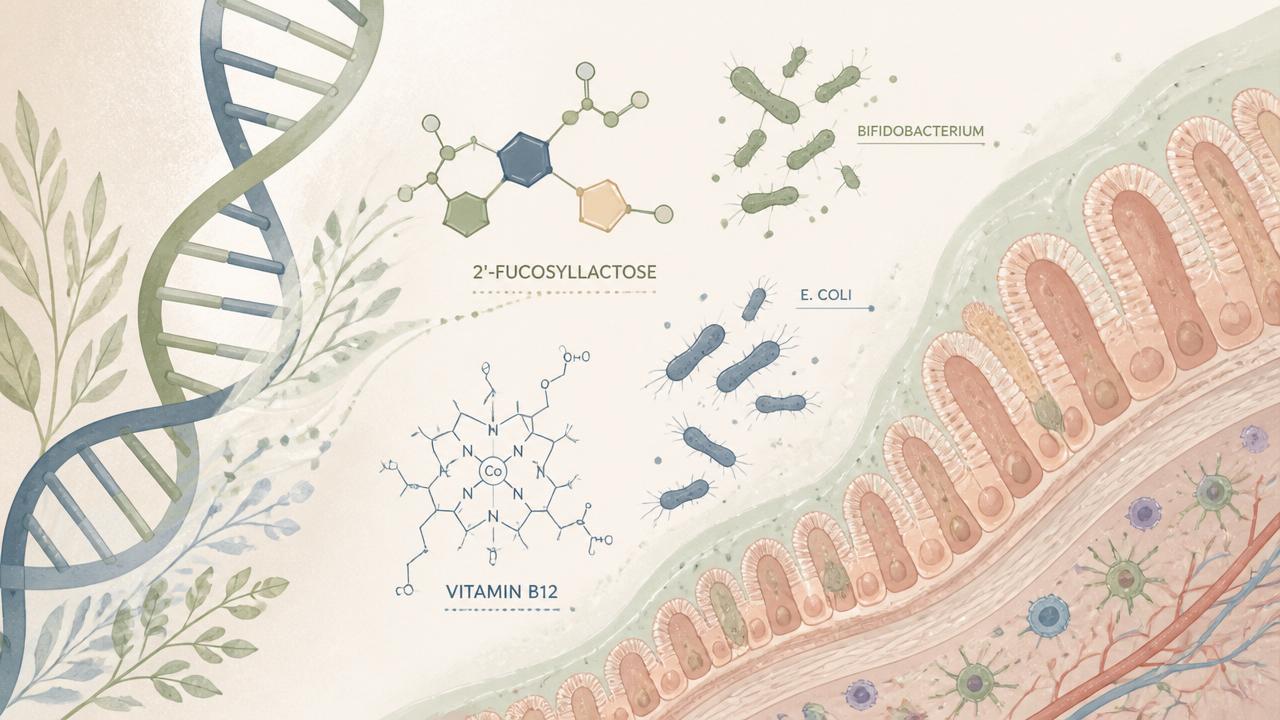
If you have ever suffered from persistent bloating, vitamin B12 deficiency despite a balanced diet, or recurrent intestinal infections, the FUT1 and FUT2 genes could be a key. These enzymes, which modify the surface of your cells and the composition of your intestinal mucus, directly influence your microbiota, your immunity, and even your risk of chronic disease. Their role is not simply about 'good' or 'bad' bacteria, but about the availability of the nutrients that feed them — and FUT1/FUT2 are the architects.
2'-fucosyllactose, produced by the FUT2 enzyme, is a prebiotic sugar with three essential roles: it feeds Bifidobacterium (anti-inflammatory bacteria), it protects the intestinal barrier by strengthening the mucus layer, and it blocks the adhesion of pathogens such as E. coli or Candida.
In FUT2 non-secretors (around 20% of Caucasians), the mucus is less glycosylated. This leads to increased intestinal permeability ('leaky gut'), a dysbiosis marked by a drop in Bifidobacterium and a rise in pathogens, and reduced absorption of vitamin B12.
FUT2 polymorphisms (rs601338) shape microbiota composition by lowering SCFA (short-chain fatty acid) producers, promoting a pro-inflammatory environment.
20% of Caucasians are non-secretors (rs601338): less fucosylated intestinal mucus.
2'-fucosyllactose produced by FUT2 feeds Bifidobacterium and blocks E. coli adhesion.
FUT2 non-secretors: ↓ Bifidobacterium, ↑ Candida and E. coli, ↓ SCFAs.
FUT2 rs601338 linked to increased risk of Crohn's disease and ulcerative colitis.
Reduced vitamin B12 absorption in non-secretors, via altered microbiota.
FUT1 and FUT2 both encode fucosyltransferases, but their targets and clinical consequences differ markedly.
| Criterion | FUT1 | FUT2 |
|---|---|---|
| Main role | Synthesis of blood group antigens (A/B/H) on red cells and mucosal surfaces. | Production of 2'-fucosyllactose (a breast-milk sugar) and fucosylation of intestinal mucus. |
| Common polymorphism | Linked to susceptibility to infections (e.g. enterotoxigenic E. coli). | rs601338 (G428A): 20% of Caucasians are non-secretors (enzyme absent). |
| Consequences | Altered mucosal immune response. | Dysbiosis (↓ Bifidobacterium, ↑ Candida, E. coli), ↓ B12 absorption, ↑ risk of IBD (Crohn's, ulcerative colitis). |
| Health impact | Increased susceptibility to infections. | Chronic inflammation, B12 deficiency, digestive issues (bloating, SIBO). |
FUT1 and FUT2 polymorphisms open the door to many nutritional and micronutritional levers, but their implementation must always be individualised. Each person is a whole: what works for one may be ineffective, or even harmful, for another.
Diet quality plays a central role in gut microbiota balance. A diet rich in fibres, omega-3 fatty acids and antioxidants supports intestinal health and modulates inflammation. Conversely, ultra-processed foods, excess refined sugar and high-temperature cooking can worsen dysbiosis and intestinal permeability.
Some supplements can be considered to support the microbiota or address specific deficiencies. For example:
Their use must, however, be assessed case by case: inappropriate supplementation can further destabilise the microbiota or mask underlying deficiencies.
Chronic stress, poor sleep or insufficient physical activity can worsen FUT1/FUT2-related imbalances. A global approach is essential:
An experienced naturopath can review your specific profile — genetic terrain, medical history, lifestyle — and propose a finely tuned, personalised plan. Some supplements can be beneficial in one respect and harmful in another: case-by-case assessment is what optimises results.
Your microbiota is not a lottery: it is a garden you can cultivate. If you carry a FUT1 or FUT2 polymorphism, targeted nutritional strategies can largely offset the effects of these variants.
Test your knowledge of FUT1/FUT2 with this 4-level exploration, from microbiota basics to nutritional strategies.
Which sugar, produced by FUT2, is essential to feed Bifidobacterium?
This exploration is educational. It does not replace medical advice. When in doubt, consult a healthcare professional. Terms and conditions →
Ce site utilise des cookies et collecte des données (e-mails, progrès dans les explorations) pour améliorer votre expérience. Lire notre politique de confidentialité.