Everywhere
Magnesium is behind almost everything: nerves, muscles, energy, sleep.
Schuchardt & Hahn, 2017

Micronutrition
the mineral we think we know
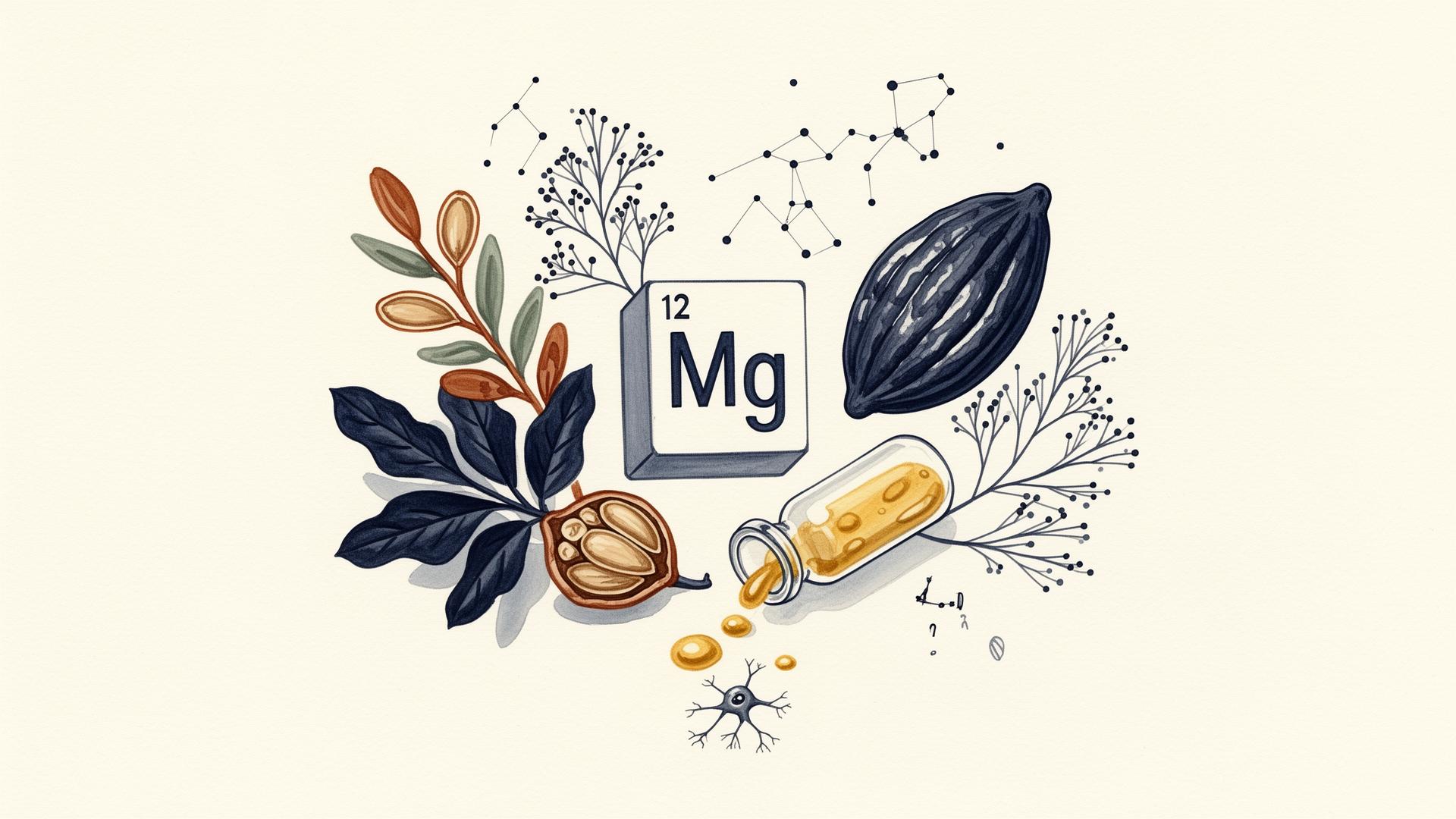
Frayed nerves, light sleep, night cramps, a twitching eyelid: often it's magnesium that's missing. It's everywhere in the body, helps muscles let go and the mind settle down. Most of us don't get enough, and not all the magnesium sold in pharmacies is the same.
Magnesium is behind almost everything: nerves, muscles, energy, sleep.
About 7 out of 10 French adults don't get enough day to day.
The cheapest, the most common, and the least absorbed.
Gentle on the gut, ideal for stress and sleep.
The only one that really reaches the brain.
Our soils hold less of it than they used to. White bread, white pasta, white rice keep very little. Coffee, ongoing stress, alcohol and some blood-pressure medicines flush more of it out through the urine. Little by little the reserve drops, without a clear crisis, and you feel it: less energy, cramps at night, broken sleep, a mood that flares easily.
Taking a supplement often makes sense. But the word "magnesium" on a box tells you almost nothing: what matters is what it's bound to, whether it gets into the bloodstream, where it acts (muscle, head, gut) and what else the capsule contains.
Magnesium oxide is everywhere: cheap, but barely any of it gets in (only 4%). Citrate is decent, mildly laxative. Bisglycinate is gentle, well tolerated, the go-to for stress and sleep. L-threonate is the only one that really reaches the brain, worth thinking about for memory and focus. Orotate heads more towards the heart. Malate helps when you wake up already tired, it gives a boost to energy production.
The little exploration below tests your eye for picking the right form for each situation. And if you want to choose yours more carefully, the dedicated exploration comes right after.
A few questions, one minute. Pick the right form for each clinical situation.
Inorganic salts, organic salts, chelated complexes, liposomal forms... Make your estimate.
Practical guide to the forms (bisglycinate, citrate, L-threonate, orotate, malate, glycerophosphate) based on your goal. Quality criteria, excipients to avoid, sources.
Read the explorationThis exploration is educational. It does not replace medical advice. In case of kidney disease, ongoing treatment or pregnancy, consult a healthcare professional. Terms and conditions →
Ce site utilise des cookies et collecte des données (e-mails, progrès dans les explorations) pour améliorer votre expérience. Lire notre politique de confidentialité.