
ADHD and HIP: similar, different, or both?
The 'zebra' label comes from high intellectual potential (HIP), not ADHD. Yet the two share much: inattention, hypersensitivity, hyperfocus, social offset. Differential diagnosis is one of the most frequent errors in adult clinical practice.
Content verified against PubMed sources 2024-2025.

The term 'zebra' was popularised in France by Jeanne Siaud-Facchin in the 2000s to describe high intellectual potential (HIP), not . The image is elegant but remains a popularisation tool: it has no peer-reviewed base and is not recognised in international clinical literature.
The confusion stems from the overlap of popular descriptions: social offset, hypersensitivity, emotional intensity, school boredom, all-or-nothing functioning. These traits appear in both profiles, but their neurobiological mechanisms are distinct, and so are their clinical implications.
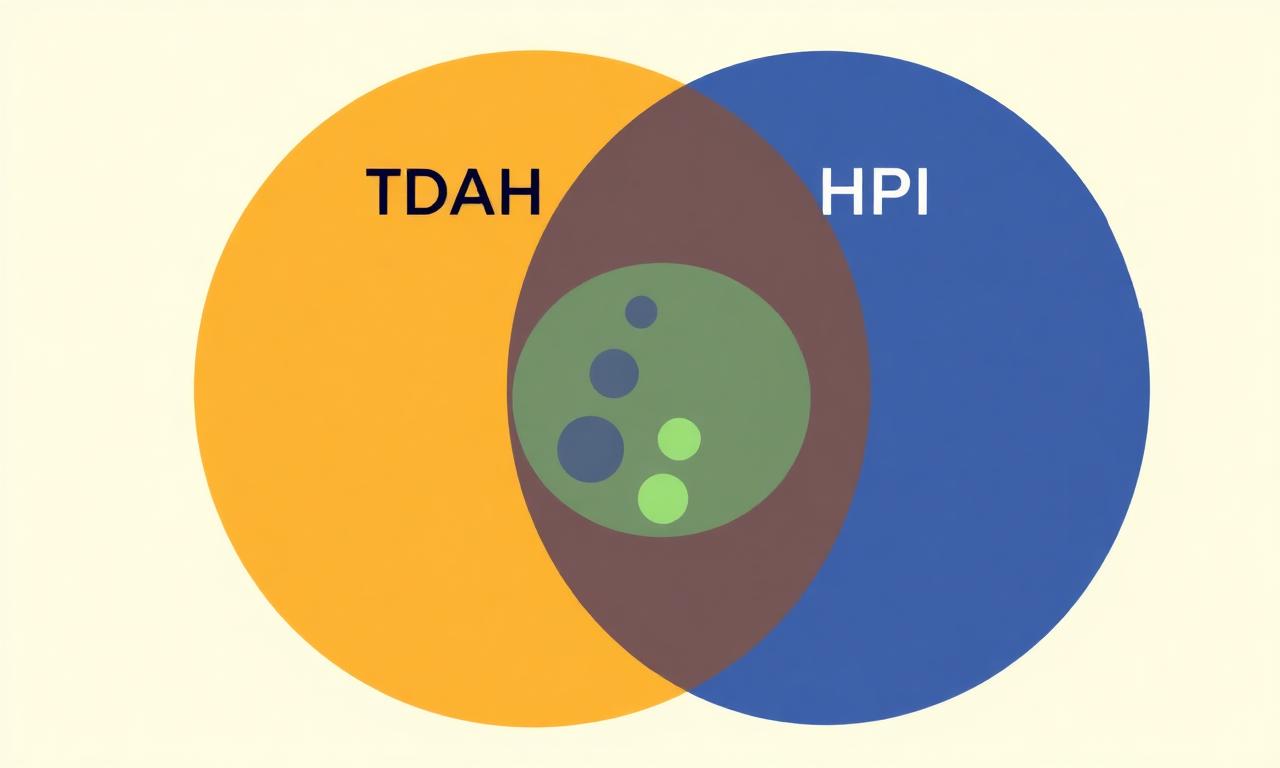
Both profiles can show inattention in class or in meetings. In HIP, it often comes from under-stimulation: the brain processes information too quickly and disengages for lack of challenge. In inattentive , it stems from a dopaminergic deficit that makes the voluntary maintenance of attention on a low-motivation task costly.
Both profiles can present sensory and emotional hypersensitivity, a social offset that makes implicit codes hard to integrate, paradoxical school difficulties (excellent results on what fascinates, collapse on what bores), and an atypical relationship to time. This phenomenological parallel is what makes the differential diagnosis tricky for non-specialist clinicians.
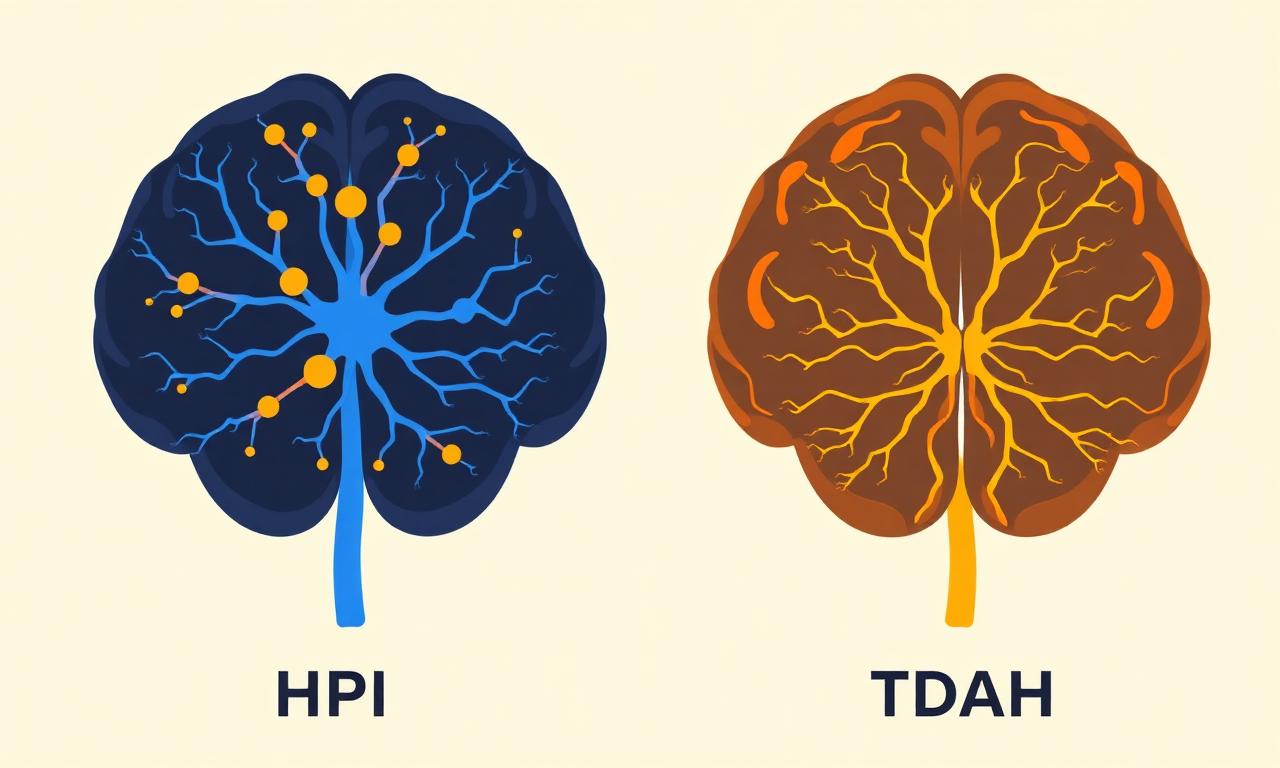
HIP is a cognitive profile defined by a total IQ or specific indices above 130 on a Wechsler scale. It is neither a disorder nor a DSM clinical category. is a neurodevelopmental disorder defined by behavioural criteria and functional impact.
Neurologically, HIP often comes with rapid information processing efficiency and a particular functional connectivity, without central dopaminergic deficit. ADHD, on the contrary, is marked by altered dopaminergic and frontostriatal signalling. This is why produces a clear attentional effect in ADHD, but no specific cognitive benefit in the absence of underlying ADHD: a high IQ alone is not enough to respond to a dopaminergic molecule.

The HIP+ dual profile is documented and probably underdiagnosed. HIP can mask an ADHD for years by compensating executive difficulties through speed of processing and memory. Decompensation typically occurs on entering contexts where cognitive compensation no longer suffices: demanding higher education in organisation, professional responsibilities, parenthood, mental load.
Spotting this dual profile changes care: neither HIP psychoeducation alone, nor ADHD treatment without cognitive support, is enough. This is a terrain where specialist evaluation makes a real difference.
An HIP misread as leads to a prescription that does not deliver the expected attentional benefit, exposes the person to side effects, and leaves aside the real levers (intellectually stimulating frame, emotional intensity management, sense-making). An ADHD masked by HIP slips under the radar for years, with personal and professional costs accumulating silently.
In either case, the life trajectory can diverge durably. This is one of the reasons why evaluation by a clinician genuinely trained in both profiles, in adulthood, is well worth the wait and the cost it represents.
Found this article useful?
Share it with someone who might need it.
Go further
Frequently asked questions
- Are HIP and ADHD the same thing?
- No. HIP describes a cognitive profile (high IQ), ADHD is a neurodevelopmental disorder defined by DSM-5 clinical criteria. The two can coexist.
- Why are the two often confused?
- Both profiles share visible symptoms: attentional disengagement, hypersensitivity, school boredom, all-or-nothing functioning. Without rigorous assessment, confusion is common.
- Does 'zebra' apply to ADHD?
- No. The term was popularised by Jeanne Siaud-Facchin to describe HIP. It has no recognised scientific base and is not used for ADHD.
- Can someone be both HIP and ADHD?
- Yes. The dual profile is documented and can complicate diagnosis, because HIP sometimes compensates ADHD symptoms into adulthood, where decompensation finally becomes visible.
- Does methylphenidate work in HIP without ADHD?
- No. Without underlying dopaminergic deficit, methylphenidate does not deliver the expected attentional benefit and exposes the person to side effects without clinical gain.